 OpsKnight
OPEN SOURCE ALTERNATIVE · AGPL-3.0
The Open-Source PagerDuty Alternative.
Eliminate restrictive per-seat subscription taxes and keep your incident data under your own custody. OpsKnight gives engineering teams open-source on-call scheduling, multi-tier escalation policies, voice phone paging, and drop-in PagerDuty Events API v2 compatibility.
Why engineers choose open source over SaaS monopolies.
Traditional on-call vendors profit from charging per user, disincentivizing broad engineering participation. OpsKnight reclaims ownership for developers.
Predictable Cost Structure
PagerDuty offers a 5-user Free tier, but scaling across engineering incurs per-user seat fees ($21 - $41+/user/mo) or platform tiers. OpsKnight AGPL-3.0 charges zero software seat fees—you pay only standard cloud hosting and direct carrier telecom.
Events API v2 Ingestion
OpsKnight provides a compatible Events API v2 ingestion adapter for monitoring tools. Repoint Datadog, Prometheus Alertmanager, or Grafana alerts by updating the endpoint and routing key (validate behavior in staging first).
Core Operational Data Custody
Incident logs, rotation calendars, escalation policies, and responder directories live in your private PostgreSQL instance. Outbound voice calls and ChatOps route through your configured Twilio, Slack, or Teams trust boundaries.
PagerDuty vs OpsKnight Side-by-Side
Examine the operational and architectural differences between PagerDuty's commercial SaaS and OpsKnight v2.0.0.
| Decision Dimension | PagerDuty Enterprise SaaS | OpsKnight v2.0.0 (Open Source) |
|---|---|---|
| License & Inspectability | Proprietary closed-source SaaS | 100% Open Source (AGPL-3.0-only) |
| Pricing & Commercial Packaging | Free (up to 5 users); paid per-user tiers ($21 - $41/mo) or platform packages | Open-source AGPL-3.0; zero software seat fees (operator pays hosting & telecom) |
| Operational Data Custody | Stored in vendor multi-tenant cloud | Private PostgreSQL DB; outbound alerts route through chosen provider boundaries |
| Events API v2 Ingestion | Native proprietary endpoint | Compatible ingestion adapter (/api/integrations/pagerduty/v2/enqueue) |
| On-Call Rotations & Overrides | Supported across all tiers | Supported with timezone handoffs & overrides |
| Escalation Policy Engine | Multi-tier delays and target rules | Multi-tier delays, target rules, channel filters |
| Phone Paging with DTMF Acknowledge | Bundled voice minutes with tier limits | Direct Twilio Voice with DTMF keypad ack/resolve at carrier rates |
| Status Page Capability | Premium add-on or separate product | 1 public/private status page included per instance |
| Identity & Provisioning | SCIM on all plans; SAML SSO on Professional & Enterprise tiers | Built-in OIDC (Okta, Azure, Google) and SCIM 2.0 in the open-source release |
| ChatOps Collaboration | Slack and Microsoft Teams integrations | Slack & Microsoft Teams incident channels & cards |
| Mobile Application | Native iOS & Android store apps | Installable PWA with push notifications |
Fast incident command without the clutter.
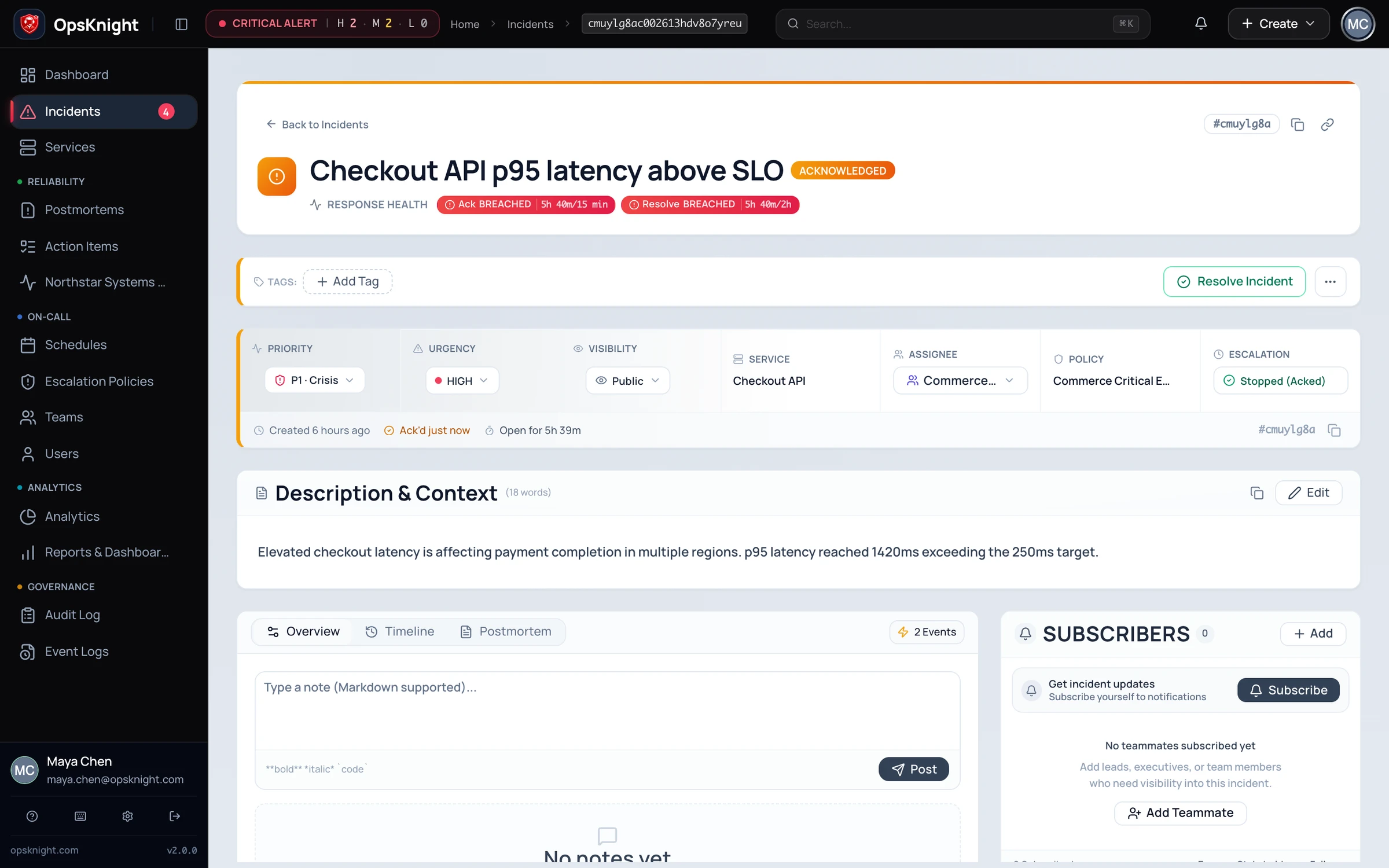
OpsKnight provides a unified incident command view: real-time signal stream, responder assignments, timeline events, ChatOps channels, and SLA tracking in one clean interface.
Voice Telephony & DTMF Ack
Receive automated voice phone calls and press 1 to claim the page directly from your phone.
Integrated Control Plane
Status pages, postmortems, and health monitoring ship inside the same deployable image.
Migrate PagerDuty Alert Ingestion to OpsKnight
OpsKnight accepts PagerDuty Events API v2 payloads directly. Inspect the contract specification and code examples below to configure your monitoring sources.
Validated Events API v2 transition
Compatibility EndpointReuse an existing Events API v2 payload only after validating the sender, routing key and lifecycle behavior in staging.
Select Your Source Stack
Migration guidance
Use this compatibility path only when the sender already emits PagerDuty Events API v2 JSON. Otherwise use OpsKnight's native adapter for that provider.
POST https://opsknight.yourcompany.com/api/integrations/pagerduty/v2/enqueue

Required lifecycle fields
routing_key   = YOUR_OPSKNIGHT_ROUTING_KEY
event_action = trigger | acknowledge | resolve
dedup_key    = stable identity reused across lifecycle events

Trigger payload also requires payload.summary, payload.severity and payload.source.
Validate trigger, acknowledge and resolve behavior before repointing production.POST /api/integrations/pagerduty/v2/enqueueTrademark & Compatibility Notice: PagerDuty® is a registered trademark of PagerDuty, Inc. OpsKnight is an independent open-source project licensed under AGPL-3.0-only and is not affiliated with, endorsed by, or sponsored by PagerDuty, Inc. Compatibility refers solely to an ingest adapter supporting the public Events API v2 JSON payload schema.
4-Step Transition Checklist & Transparent Cost Model
A structured roadmap to validate OpsKnight in staging and trigger your first successful test alert.
Transition Checklist
- 1.Audit Existing Senders: Inventory Datadog, Prometheus, Grafana, and custom webhook sources currently routing to PagerDuty.
- 2.Staging Validation: Repoint a pilot monitoring service to
/api/integrations/pagerduty/v2/enqueueand verify trigger/ack/resolve events. - 3.Telephony Verification: Connect your Twilio credentials and execute a live phone call test to verify DTMF keypad acknowledgment.
- 4.Cutover & Decommission: Migrate production alert routes, verify ChatOps channels, and decommission legacy subscriptions.
Transparent Cost Breakdown
Zero software license markup. All carrier telecom and infrastructure costs are billed directly by your own cloud/telecom providers.
Open-Source PagerDuty Alternative FAQ
Answers to technical, operational, and licensing questions about adopting OpsKnight.
How does OpsKnight provide compatibility with PagerDuty?
OpsKnight provides an Events API v2 ingestion adapter at /api/integrations/pagerduty/v2/enqueue. Inbound monitoring tools (such as Datadog, Prometheus Alertmanager, Grafana, or AWS CloudWatch) configured to dispatch PagerDuty v2 triggers, acknowledgments, and resolutions can route alerts to OpsKnight by updating the webhook target URL and routing key. Administrative REST APIs and vendor-specific workflows must be configured natively in OpsKnight. Teams should validate routing-key mapping and deduplication in staging before repointing production.
Why choose an open-source alternative over PagerDuty SaaS?
Organizations choose OpsKnight for three primary reasons: 1) Predictable cost structure: While PagerDuty offers a Free tier for up to 5 users, expanding on-call coverage across engineering incurs per-user seat fees (typically $21 - $41/user/mo billed annually) or platform packaging. OpsKnight has zero software seat fees under AGPL-3.0. 2) Operational data custody: Your incident records, escalation schedules, and server metadata remain in your PostgreSQL database. 3) Operational autonomy: Your core scheduling and triage pipeline runs on your infrastructure, independent of third-party SaaS management consoles.
How does phone and SMS paging compare to PagerDuty?
OpsKnight connects directly to your own configured Twilio account for voice telephony and SMS dispatch. Responders hear synthesized incident summaries and can press 1 on their keypad (DTMF) to acknowledge or 2 to resolve immediately. Because you connect your own Twilio account, you pay transparent carrier telecom rates directly with zero software vendor markup.
How does Single Sign-On (SSO) and SCIM provisioning compare?
PagerDuty documents SCIM provisioning across all plans (including Free) and SAML SSO on its Professional and Enterprise tiers. OpsKnight provides built-in OpenID Connect (OIDC) supporting Okta, Azure AD / Entra ID, Keycloak, and Google Workspace, along with SCIM 2.0 user and team synchronization directly in the open-source AGPL-3.0 release without licensing tier restrictions.
How do you achieve high availability with a self-hosted deployment?
For production environments requiring high availability, OpsKnight supports a Split Runtime topology separating web/API processes from background task workers, deployed across redundant nodes in Kubernetes or Docker Swarm, paired with a resilient, managed PostgreSQL cluster (such as AWS RDS Multi-AZ or Patroni).
What mobile experience does OpsKnight offer for on-call responders?
OpsKnight features an installable Progressive Web Application (PWA) with responsive design, push notifications, and fast touch interactions. Responders can acknowledge, escalate, or resolve incidents directly from their mobile browser or installed PWA icon without downloading proprietary vendor app store binaries.
Your incidents should belong to you.
Run OpsKnight on infrastructure you control.
v2.0.0 · AGPL-3.0-only · Self-hosted · 28 inbound integrations