 OpsKnight
Workers, queues and providers tell different stories.
Inspect worker heartbeat, oldest pending job age and provider state together. A growing critical queue has a different operational priority from delayed bulk work.
Read the operational guideOPERATIONS
Choose integrated or split runtimes and inspect worker health, delivery operations, metrics and logs.
WHAT IT SOLVES
Choose an integrated process or separate Web, Scheduler, General Worker, Critical Worker, Bulk Worker and Status Projector. A split runtime alone does not provide high availability.
Understand the capability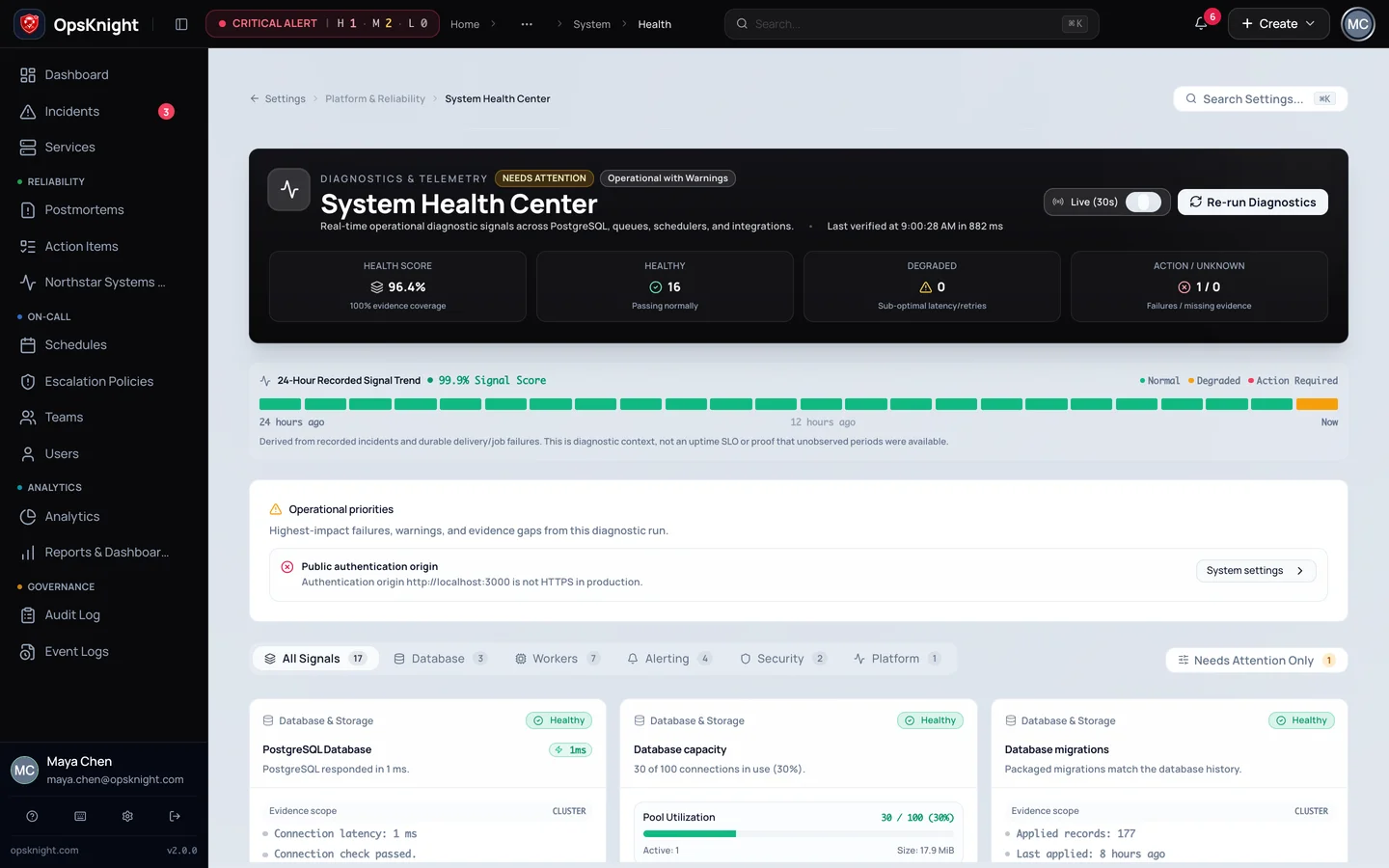
HOW IT WORKS
EXPLORE A WORKFLOW
The integrated runtime is the simplest operating model. Monitor database capacity, provider health and background work together.
OPERATIONAL DEPTH
The details below are the parts teams need when evaluating how the capability behaves during real response, failure, and handoff.
Inspect worker heartbeat, oldest pending job age and provider state together. A growing critical queue has a different operational priority from delayed bulk work.
Read the operational guideInclude each role’s replica count and pool size in the connection budget. More workers can exhaust database capacity instead of improving queue latency.
Read the operational guideFollow the documented transaction-pooling and direct-connection requirements. Schema management and runtime traffic must use the connection paths appropriate to their work.
Read the operational guideUse the Health Center to inspect recorded diagnostics and operational priorities. Connect documented health and Prometheus metrics to your own monitoring, and interpret component status rather than only HTTP status.
Read the operational guideScale the constrained role only after checking database and provider capacity. Plan backups, upgrades, ingress and recovery together for production availability.
Read the operational guideKNOW BEFORE PRODUCTION
Use a test service and representative provider configuration before treating operations as production incident infrastructure.
RUNTIME OPTIONS
Run OpsKnight on infrastructure you control.
v2.0.0 · AGPL-3.0-only · Self-hosted · 28 inbound integrations