 OpsKnight
MIGRATION TARGET · OPSGENIE SUNSET 2027
The Dedicated Opsgenie Alternative for 2027.
Atlassian has announced that standalone Opsgenie sales have ended, and all support concludes on April 5, 2027. Don't let forced vendor migrations push your team into expensive, complex cloud ticketing suites. OpsKnight provides an open-source, self-hosted on-call and incident platform you operate on your own terms.
Key Sunset Milestones for Opsgenie Customers
• June 4, 2025: New sales of standalone Opsgenie ended.
• April 5, 2027: End of Support (EOL) for all standalone Opsgenie accounts.
Evaluating your path forward before 2027.
When a core operational platform sunsets, engineering organizations typically face two choices: adopt the vendor's recommended cloud suite, or take back control with modern self-hosted infrastructure.
Migrate to Jira Service Management (JSM) Cloud
Atlassian provides an automated migration assistant to help eligible customers transition supported Opsgenie configurations into JSM Cloud. For organizations already invested in Jira, this automated path migrates teams and schedules directly, with distinct trade-offs to evaluate:
- Automated migration assistant transfers supported schedules and services
- Per-agent seat licensing that scales as more responders join rotations
- ITSM ticketing suite scope rather than a dedicated on-call response tool
- Multi-tenant vendor cloud hosting without a self-hosted on-premises option
Dedicated Self-Hosted On-Call with OpsKnight
Retain dedicated, purpose-built on-call rotations and incident management on your own terms. OpsKnight is built specifically for SRE and platform teams who demand operational autonomy:
- Zero per-user software fees under the inspectable AGPL-3.0 license
- Core database custody: alerts, schedules, and user records live in your PostgreSQL
- Autonomous control plane: event triage runs locally, independent of SaaS consoles
- Direct Twilio voice telephony: press-key phone paging at carrier cost
Rotations that feel familiar to Opsgenie users.
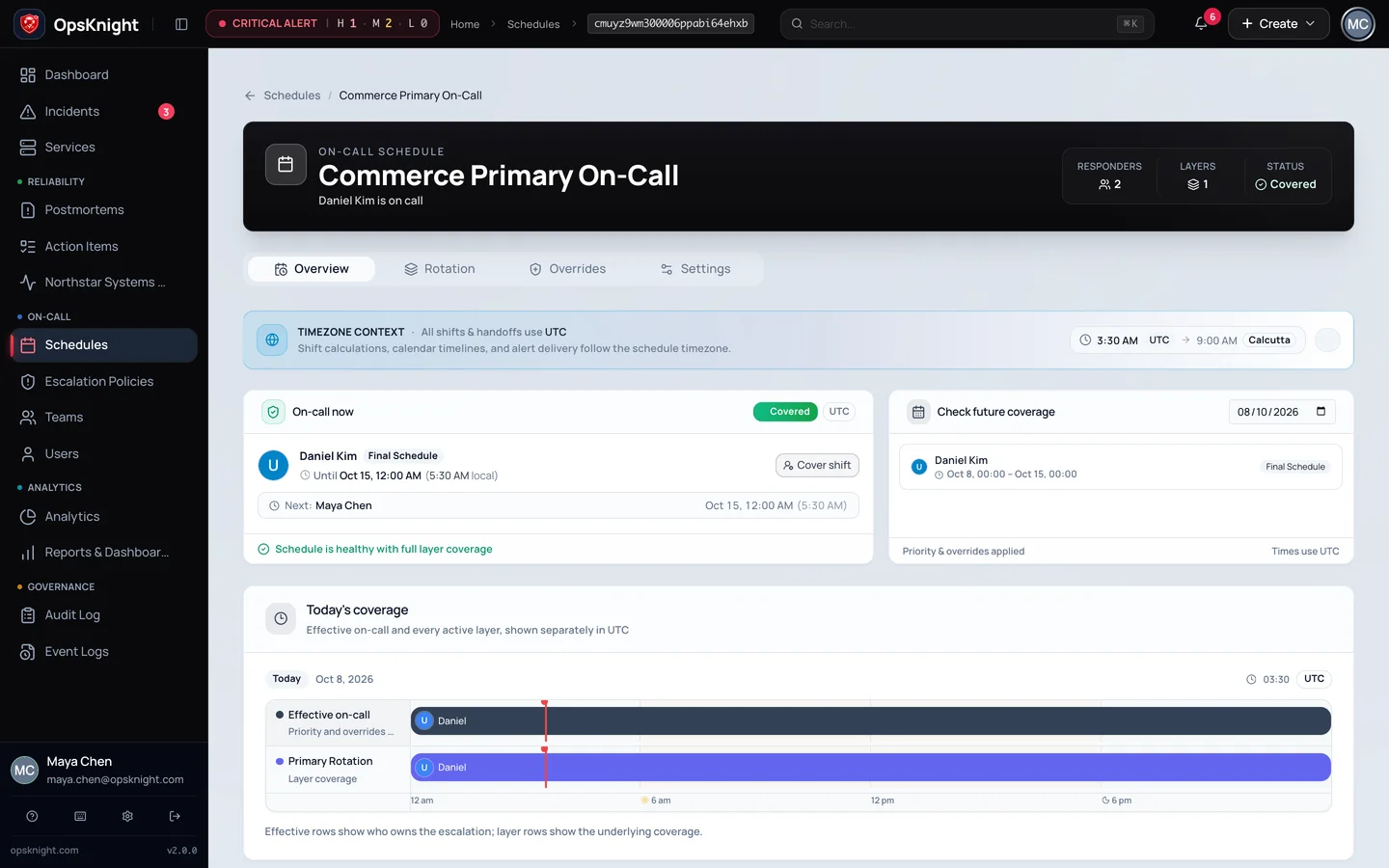
OpsKnight supports the scheduling patterns your teams already use: multi-layer daily and weekly rotations, custom intervals, holiday and shift overrides, and timezone alignment.
Shift Overrides Without Schedule Drift
Cover for a teammate with temporary overrides that expire automatically.
Multi-Tier Escalation Delays
Route to primary schedule at 0m, secondary at 5m, and team leads at 15m until acknowledged.
100% On-Premises Schedule Data
Never worry about third-party vendors deprecating APIs or locking your schedule data.
Opsgenie vs OpsKnight Feature Comparison
Direct architectural comparison between standalone Opsgenie and OpsKnight v2.0.0.
| Capability Dimension | Standalone Opsgenie | OpsKnight v2.0.0 |
|---|---|---|
| Deployment Ownership | Vendor-hosted Atlassian Cloud only | Self-hosted on your VPC / Bare Metal / Kubernetes |
| Product Lifecycle Status | Sunset announced; EOL April 5, 2027 | Active release (v2.0.0), perpetual open-source license |
| Pricing Model | Per-user monthly subscription (or JSM Cloud tier) | Free open-source AGPL-3.0 license; unlimited users |
| On-Call Rotations & Overrides | Daily, weekly, custom schedules with overrides | Daily, weekly, multi-layer schedules with overrides |
| Multi-Tier Escalation Policies | Multi-step delays with team and schedule targets | Multi-step delays with target fallbacks and channel rules |
| Voice & SMS Notification Costs | Bundled into tiers with regional limits & overages | Direct-to-carrier via your own Twilio account at cost |
| DTMF Voice Call Acknowledgment | Press-key to acknowledge during live phone page | Press 1 to acknowledge, 2 to resolve via Twilio Voice |
| Customer Status Page Included | Requires separate Atlassian Statuspage subscription | 1 integrated public/private status page included |
| Operational Data Custody | Alert payloads stored in multi-tenant Atlassian Cloud | Private PostgreSQL DB; outbound notifications route through chosen provider boundaries |
| Migration Path Provided | Atlassian automated migration tool into JSM Cloud | Standard schedule/policy mapping and webhook repointing |
| ChatOps Collaboration | Slack & Microsoft Teams integrations | Slack & Microsoft Teams incident channels & cards |
| Mobile App Access | Native iOS and Android store apps | Installable PWA with push notification support |
5-Step Migration Blueprint from Opsgenie to OpsKnight
Follow this phased migration framework to systematically transition on-call services before the 2027 deadline.
Inventory Services
List active Opsgenie alert rules, teams, on-call schedules, and escalation policies.
Spin Up Runtime
Launch OpsKnight via Docker Compose or Helm. Attach your PostgreSQL instance and configure OIDC/SCIM.
Recreate Rotations
Define user notification profiles, build schedule rotations, and set escalation rules.
Dual-Send Webhooks
Send alerts to OpsKnight in staging. Verify deduplication, routing keys, and phone paging.
Decommission Opsgenie
Switch production alerting traffic, cancel Opsgenie renewal, and eliminate seat fees.
Repointing Opsgenie Ingestion to OpsKnight
Inspect verified configuration recipes for Prometheus Alertmanager, Datadog webhooks, and HTTP payloads.
Opsgenie Migration Blueprint
Self-Hosted AlternativeMap Opsgenie concepts to OpsKnight, then validate schedules, routing and paging before changing production senders.
receivers:
  - name: 'opsknight-primary'
    webhook_configs:
      - url: 'https://opsknight.yourcompany.com/api/integrations/prometheus?integrationId=YOUR_INTEGRATION_ID'
        send_resolved: true

route:
  receiver: 'opsknight-primary'
  group_by: ['alertname', 'cluster', 'service']
  group_wait: 30s
  group_interval: 5m
  repeat_interval: 4h
  routes:
    - match:
        severity: critical
      receiver: 'opsknight-primary'
Replace opsgenie_configs in Alertmanager with OpsKnight's native Prometheus webhook receiver.
Trademark Notice: Opsgenie and Jira Service Management are registered trademarks of Atlassian Pty Ltd. OpsKnight is an independent open-source project and is not affiliated with, endorsed by, or sponsored by Atlassian.
Opsgenie 2027 Sunset & Migration FAQ
Common questions from SRE, DevOps, and Platform teams planning their transition away from Opsgenie.
When is the official Opsgenie end-of-life (EOL) date?
Atlassian announced that new sales of standalone Opsgenie ended on June 4, 2025, and all support for standalone Opsgenie ends on April 5, 2027. After this date, standalone Opsgenie will no longer be available or supported.
Why should teams evaluate OpsKnight instead of moving to Jira Service Management (JSM)?
Atlassian offers an automated migration assistant to help eligible Opsgenie customers transition into Jira Service Management (JSM) Cloud. For teams standardized on Jira ticketing, that automated path is convenient. However, many engineering and platform teams prefer not to tie their real-time on-call rotations to an ITSM ticketing suite with per-agent seat pricing. OpsKnight gives teams full custody over their operational database, runs on self-hosted Docker Compose or Kubernetes, charges zero software seat fees under AGPL-3.0, and provides dedicated on-call and incident response tooling without ticketing overhead.
How does OpsKnight handle on-call schedules and escalations compared to Opsgenie?
OpsKnight replicates the core on-call capabilities of Opsgenie: timezone-aware rotation schedules, shift overrides, multi-stage escalation policies with configurable delay intervals, conditional channel delivery, and team-based routing. All schedule configurations and responder contacts live within your own PostgreSQL database.
Can we still use our existing alerting sources (Prometheus, Datadog, Grafana, CloudWatch)?
Yes. OpsKnight provides first-class native webhook integrations for Prometheus Alertmanager, Datadog, Grafana, AWS CloudWatch, and custom generic webhooks. In most cases, migration involves simply updating your webhook destination URL and integration key.
How does telephone and SMS notification work in a self-hosted platform?
OpsKnight connects to your own configured Twilio account for voice telephony and SMS delivery. Responders receive real phone calls with interactive DTMF acknowledgment ('Press 1 to acknowledge'), eliminating vendor markups on notification telecom and keeping telecom credentials under your control.
Is OpsKnight free to deploy and operate?
OpsKnight v2.0.0 is open-source software under the GNU AGPLv3 license. You can freely deploy and operate it on your own servers or cloud infrastructure. Optional enterprise commercial support and implementation assistance are available directly from the core maintainers.
Your incidents should belong to you.
Run OpsKnight on infrastructure you control.
v2.0.0 · AGPL-3.0-only · Self-hosted · 28 inbound integrations