
Core Concepts2 min read
Technical Architecture
Comprehensive System Architecture, Data Flow, and Component Design.
Technical Architecture
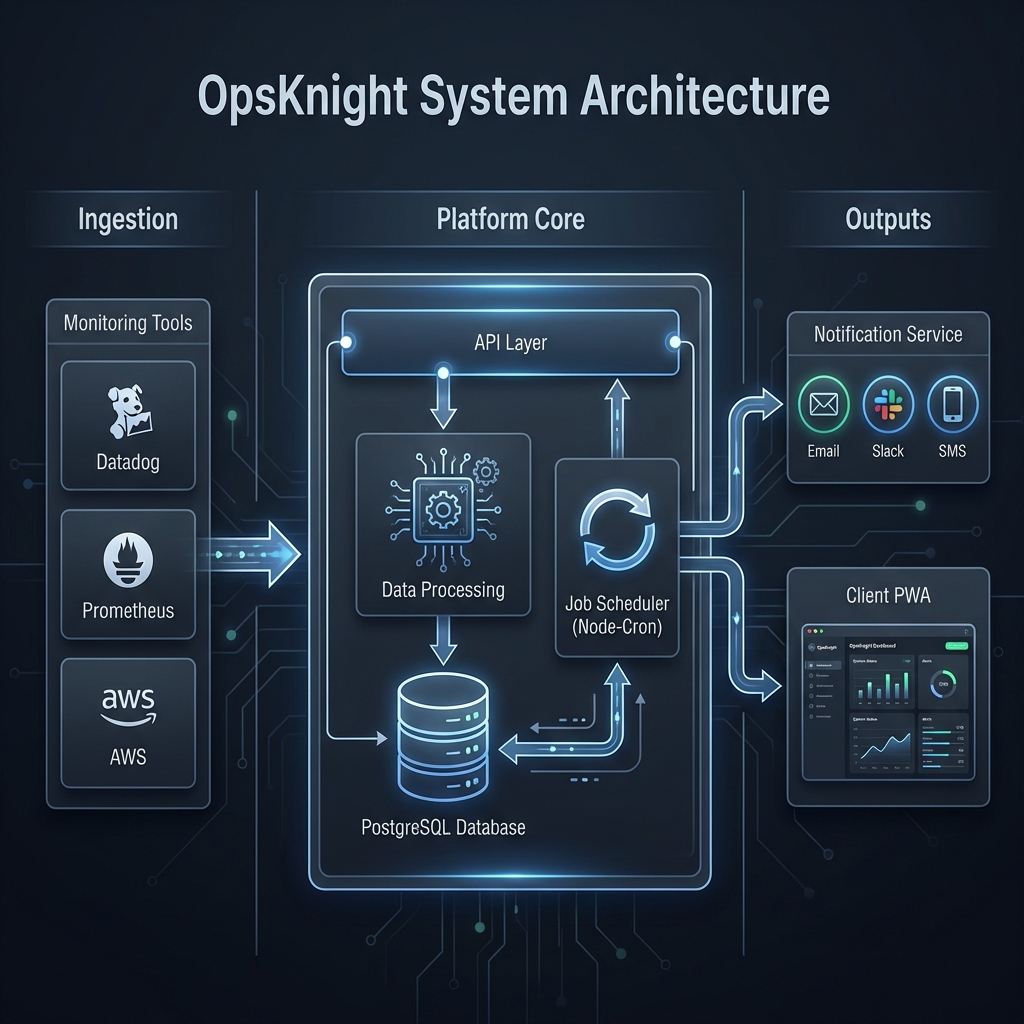
OpsKnight is designed as a cloud-native, event-driven platform built on the Next.js App Router. It separates the Control Plane (User Interaction & API) from the Worker Plane (Reliability & Async Processing) to ensure high availability and zero-data-loss for critical alerts.
High-Level System Architecture
The following diagram details the System Logic Flow, mapping exactly how data moves through the ingestion pipeline, the database, and the asynchronous reliability engine.
Core Subsystems
1. Ingestion Pipeline (The "Funnel")
The entry point for all chaos.
- Normalization: The
APIlayer accepts generic webhooks or provider-specific payloads (Datadog, Prometheus). It normalizes them into a standardGenericEventschema. - Deduplication: Before persisting, the engine checks for existing open incidents with the same
dedup_keyto prevent alert storms. - Enrichment: Metadata is added (Service ownership, tagging) before the incident is written to Postgres.
2. Background Processing (Cron)
We use node-cron for reliable background task scheduling within the main application instance.
- Mechanism: A scheduled task runner initializes on server startup (
server.ts). - Core Responsibilities:
- Escalation Processing: Polls every minute for incidents requiring escalation steps.
- SLA Monitoring: Checks for SLA breaches and updates status snapshots.
- Data Retention: Specific jobs (like
data-cleanup.ts) handle pruning of old logs and metrics.
- Reliability:
- Atomic Operations: Uses Prisma transactions to ensure data consistency during processing.
- Idempotency: Jobs are designed to be safe to run multiple times (skip if already processed).
3. The PWA (Client)
The frontend is a Progressive Web App built with Next.js App Router.
- Optimistic UI: Use of
useOptimistichooks ensures the UI feels instant (e.g., when clicking "Acknowledge"), while the server processes the request in the background. - Service Workers: Handles
web-pushevents to wake up the potential responder even if the browser tab is closed. - Data Fetching: Hybrid approach using Server Components for initial load and efficient client-side polling/revalidation for live updates.
4. Security & Compliance
- Authentication: Managed via
NextAuth.js, supporting generic OIDC and Email Magic Links. - RBAC: Role-Based Access Control checks are enforced at the API Handler level.
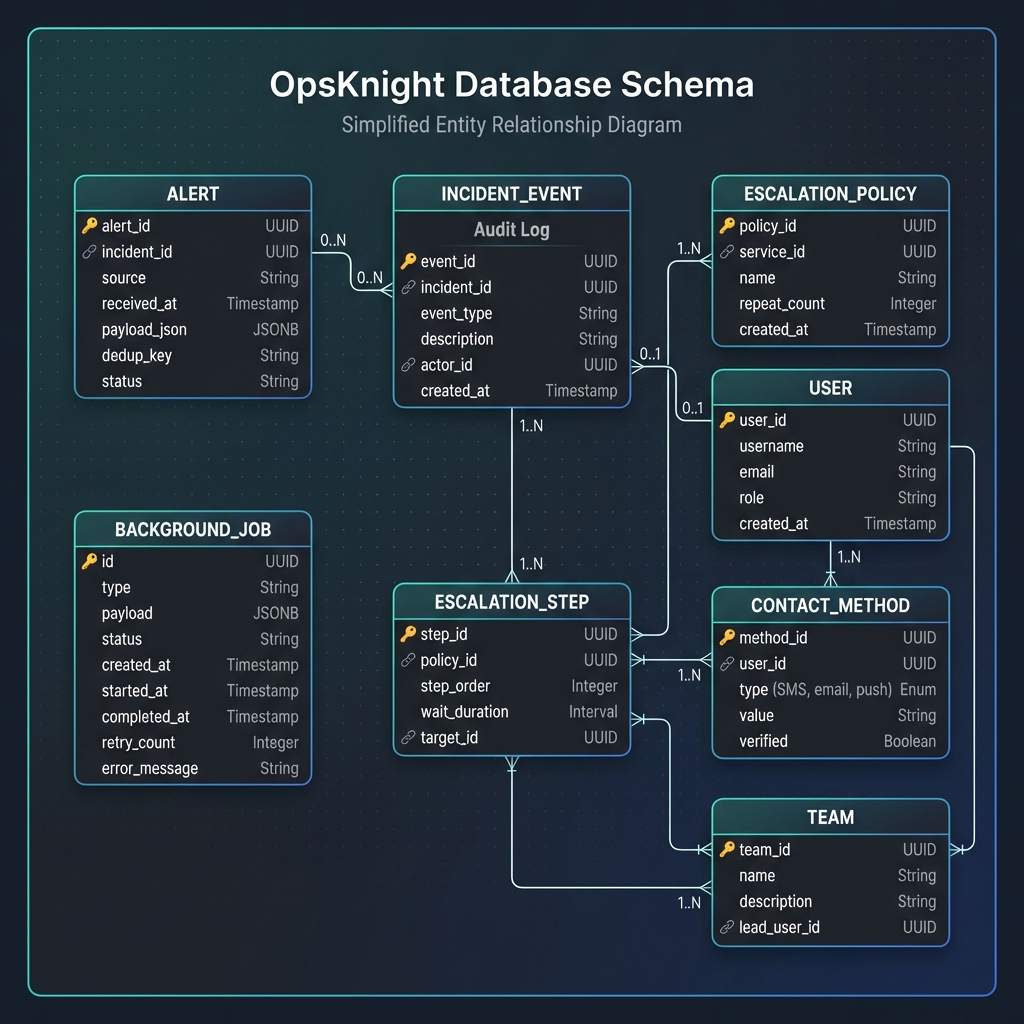
- Audit Trails: Every state change is written to an immutable
IncidentEventledger.
Data Schema (Simplified)
Last updated for v1
Edit this page on GitHub